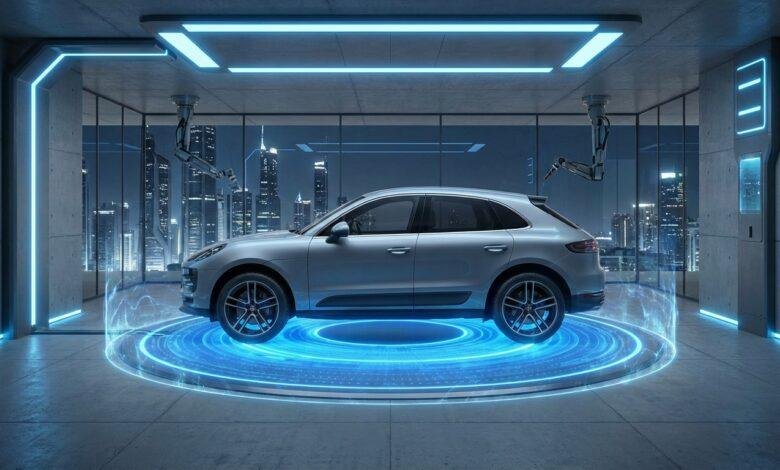
The Cable-Free Future Arrives
Imagine pulling into your garage after a long day, and your electric vehicle starts charging automatically—no cables, no connectors, no hassle. This isn’t science fiction anymore. Wireless EV charging 2026 is here, and Porsche is positioning itself at the forefront of this game-changing technology.
For years, EV owners have accepted the daily ritual of plugging in their vehicles as a necessary inconvenience. But as the electric car charging landscape evolves, wireless charging promises to eliminate one of the last remaining friction points in the EV ownership experience. Porsche’s aggressive push into inductive charging technology signals that cable-free power transfer is moving from experimental concept to mainstream reality.
How Wireless EV Charging Works
Wireless EV charging relies on electromagnetic induction—the same technology that powers your electric toothbrush, just scaled up significantly. Here’s the basic principle: a charging pad installed on the ground contains a coil that generates an alternating magnetic field. When your EV parks over it, a receiver coil in the vehicle’s undercarriage captures this energy and converts it back to electricity to charge the battery.
The efficiency of these systems has improved dramatically. Modern wireless charging solutions can achieve 90-95% efficiency, compared to the 95-99% efficiency of traditional plug-in charging. While there’s still a small energy loss, the convenience factor makes it worthwhile for many drivers.
The best electric cars of 2026 are increasingly being designed with wireless charging compatibility in mind. Manufacturers are embedding receiver coils into vehicle platforms during production rather than offering them as aftermarket add-ons, ensuring better integration and performance.
Porsche’s Leadership in Wireless Charging Technology
Porsche has never been a company to follow trends—it creates them. The German automaker’s approach to wireless EV charging 2026 reflects its broader philosophy of blending performance with cutting-edge innovation.
The company’s Mission R concept and production models like the Taycan have served as testbeds for advanced charging technologies. Porsche Engineering has developed proprietary wireless charging systems capable of delivering 11 kW of power—enough to fully charge a Taycan overnight. But they’re not stopping there. Research teams are actively testing 300 kW wireless systems that could theoretically add 60 miles of range in just 10 minutes.
Porsche’s parent company, Volkswagen Group, has announced plans to make wireless charging available across multiple brands by late 2026. This standardization effort could accelerate adoption industry-wide, similar to how the CCS charging standard gained traction.
The Real-World Benefits of Wireless Charging
The advantages of cable-free charging extend far beyond mere convenience. For fleet operators managing dozens or hundreds of vehicles, wireless charging eliminates the wear and tear associated with constant cable plugging and unplugging. It also removes the risk of charging equipment being damaged or vandalized.
Residential users benefit from the “set it and forget it” nature of wireless systems. Park your car in the garage, and charging begins automatically. No more forgetting to plug in overnight and waking up to a depleted battery. This seamless experience is particularly valuable for owners of popular EVs like the Tesla Model Y and other daily drivers.
Weather protection is another significant advantage. Traditional charging ports can ice over in winter or accumulate debris. Wireless systems are completely sealed and weatherproof, operating reliably in rain, snow, and extreme temperatures.
2026: The Tipping Point for Wireless EV Charging
Several factors are converging to make 2026 the breakthrough year for wireless EV charging. Infrastructure investment is accelerating, with major charging network providers adding wireless pads to their locations. The expansion of EV charging stations now includes wireless-enabled parking spaces at airports, shopping centers, and office complexes.
Standardization efforts led by organizations like the Society of Automotive Engineers (SAE) have established technical specifications ensuring interoperability between different vehicle and charging pad manufacturers. This means your Porsche won’t be locked into proprietary charging equipment.
Cost reductions are also driving adoption. As production scales up, wireless charging hardware prices have dropped by approximately 40% since 2023. Combined with available tax credits and incentives, residential wireless charging installation has become financially accessible to mainstream consumers.
Challenges and Limitations
Despite its promise, wireless EV charging isn’t without challenges. The technology currently commands a premium—typically $2,500-$4,000 for residential installation compared to $500-$1,500 for a high-quality Level 2 wall charger. Vehicle manufacturers also charge extra for wireless charging capability, often bundling it with luxury trim packages.
Alignment precision matters. While modern systems have some tolerance for parking position, drivers still need to park reasonably accurately over the charging pad. Advanced autonomous parking systems that can position vehicles perfectly over wireless chargers are beginning to address this limitation.
Energy efficiency concerns persist. The 5-10% energy loss in wireless transmission adds up over thousands of charging cycles. For environmentally conscious owners calculating their carbon footprint, this inefficiency matters, especially when calculating the cost to charge EV at home.
Dynamic Wireless Charging: The Next Frontier
While static wireless charging (park and charge) is becoming mainstream, dynamic wireless charging represents the ultimate vision. Imagine driving on highways that continuously charge your vehicle through embedded charging coils. Your EV’s battery could be smaller and lighter because it’s constantly being topped up while driving.
Porsche has partnered with European infrastructure developers to test dynamic charging on limited road segments. These trials involve specially equipped test vehicles receiving power at highway speeds. While widespread deployment remains years away, the technology demonstrates what’s possible.
Sweden has already built several kilometers of “electric road” using overhead conductive charging, while Germany and France are testing inductive versions. The data collected from these pilot programs will inform future infrastructure decisions.
Competition: Beyond Porsche
Porsche may be leading the charge in the luxury segment, but other manufacturers are pursuing wireless technology aggressively. BMW has integrated wireless charging into its iX lineup, while Mercedes-Benz offers the technology on its EQS sedans. Hyundai and Kia have made wireless charging available on their Ioniq 5 and EV6 models, bringing the technology to more affordable price points.
Chinese manufacturers like BYD are incorporating wireless charging as standard equipment on premium models. As competition intensifies, prices will continue falling, and wireless charging will transition from luxury option to expected feature.
Commercial vehicle applications are advancing rapidly. Delivery vans, taxis, and buses that operate on predictable routes can benefit enormously from opportunity charging at stops. Ford’s F-150 Lightning and commercial EVs from Rivian are being developed with fleet wireless charging in mind.
What This Means for EV Owners
If you’re considering an EV purchase in 2026, wireless charging capability should be on your feature checklist. Even if you don’t install home equipment immediately, having the hardware ensures future-proofing as public wireless infrastructure expands.
For current EV owners, aftermarket wireless charging kits are becoming available for popular models. These retrofit solutions typically involve installing a receiver pad under the vehicle and connecting it to the existing charging port. While not as elegant as factory integration, they offer an upgrade path.
Battery longevity considerations remain important. The impact of frequent partial charging sessions (which wireless charging encourages) on long-term EV battery life is still being studied. However, current research suggests that keeping batteries between 20-80% state of charge actually promotes longevity compared to deep discharge cycles.
FAQ: Wireless EV Charging 2026
Is wireless EV charging safe?
Yes, wireless charging systems are extremely safe. They use magnetic fields that only extend a few inches from the charging pad and automatically shut off when no compatible vehicle is detected. The technology meets all automotive safety standards and poses no risk to passengers, pets, or electronics.
How fast is wireless EV charging compared to plugging in?
Current wireless systems deliver 11 kW, comparable to a Level 2 home charger. This adds approximately 30-40 miles of range per hour. Faster 22 kW and 300 kW systems are in development but not yet widely available for consumer vehicles.
Can I add wireless charging to my existing EV?
Aftermarket wireless charging solutions exist for some popular models, but factory integration provides better efficiency and reliability. Check with your vehicle manufacturer about compatibility before purchasing third-party equipment.
Does wireless charging work in bad weather?
Wireless charging systems are sealed and weatherproof, functioning reliably in rain, snow, and temperature extremes. In fact, they often outperform plugged connections in harsh conditions since there are no exposed connectors to ice over or corrode.
Will wireless charging damage my EV’s battery?
No, wireless charging is gentler on batteries than DC fast charging. The slower, steady power transfer generates less heat, which is the primary factor in battery degradation. Most wireless systems also include smart charging software that optimizes charging speed based on battery temperature and state of charge.
The Bottom Line
Wireless EV charging 2026 represents more than just a convenience upgrade—it’s a fundamental shift in how we interact with electric vehicles. Porsche’s leadership in this space demonstrates that luxury automakers see cable-free charging as essential to the premium EV experience.
As infrastructure expands and costs decrease, wireless charging will become as commonplace as backup cameras or Bluetooth connectivity. The technology addresses real pain points in EV ownership while paving the way for future innovations like dynamic charging roads.
For prospective EV buyers, wireless charging capability is increasingly a must-have feature. The ability to simply park and walk away while your vehicle charges itself eliminates the last bit of friction from the electric driving experience. Combined with the continued development of next-generation battery technologies, wireless charging helps make 2026 the most compelling year yet to transition to electric mobility.
The cable-free revolution isn’t coming—it’s already here. And Porsche is making sure you’ll never have to fumble with a charging cable again.