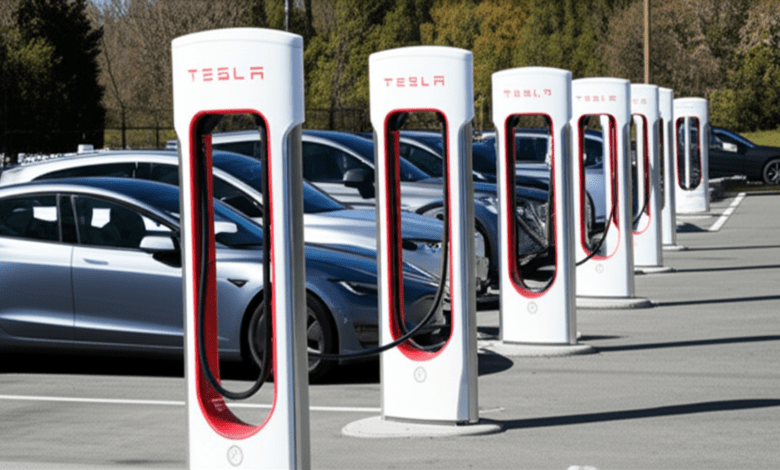
Tesla’s decision to open its proprietary Supercharger network to all electric vehicles represents the most significant infrastructure development in EV history. After years of exclusive access for Tesla owners, the tesla supercharger network now welcomes drivers of Ford, Rivian, Mercedes, BMW, and virtually every other electric vehicle brand. This transformation, completed in early 2026, fundamentally changes the charging landscape and addresses the primary concern preventing EV adoption.
The Supercharger network has long represented Tesla’s moat against competitors. While other automakers focused on vehicle development, Tesla built charging infrastructure that made long-distance electric travel practical years before competitors caught up. Learn more about EV charging options in your area.
The Magic Dock Solution
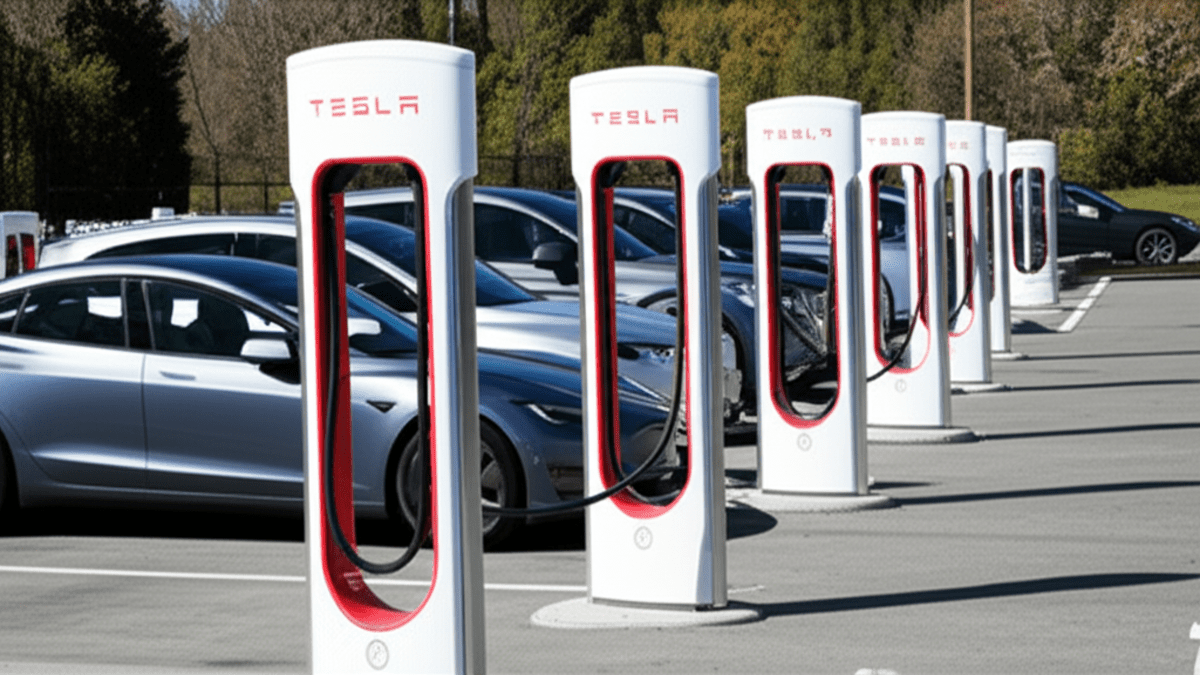
Tesla’s Magic Dock technology solves the connector compatibility challenge that previously prevented universal Supercharger access. The integrated adapter attaches directly to V3 and V4 Supercharger stalls, allowing CCS-equipped vehicles to connect to Tesla’s proprietary connectors. When not in use, the Magic Dock retracts seamlessly into the charging cable housing.
This solution eliminates the adapter mess that plagued early CCS-to-Tesla experiments. Drivers simply park, press the Magic Dock release button, and connect to their vehicle’s CCS port. The system automatically recognizes the vehicle and begins charging, with Tesla’s app handling payment and session management regardless of vehicle brand.
Pricing and Access Changes
Non-Tesla vehicles pay premium rates compared to Tesla owners, reflecting the infrastructure investment and business reality of serving competitors. While Tesla owners maintain rates averaging $0.25 per kWh, non-Tesla vehicles pay approximately $0.35-$0.45 per kWh depending on location and time of day. Check available EV tax incentives that might offset charging costs.
Membership programs reduce these costs significantly. The Tesla Charging Membership, available to any EV owner for $12.99 monthly, reduces rates to roughly $0.30 per kWh—competitive with Electrify America and other networks. For frequent travelers, this membership pays for itself after just a few charging sessions.
Real-World Reliability Improvements
The Tesla Supercharger network’s legendary reliability stems from Tesla’s vertical integration approach. Unlike third-party networks that rely on disparate hardware and software from multiple vendors, Tesla controls the entire charging stack from station design to payment processing. This integration produces uptime rates exceeding 99%, dramatically better than competitors struggling with 70-80% availability.
Non-Tesla owners report overwhelmingly positive experiences since network opening. Charging sessions initiate reliably, speeds meet or exceed expectations, and the Tesla app provides real-time stall availability that reduces range anxiety. The contrast with frustrating experiences at Electrify America and other networks proves stark for drivers switching between charging providers.
Impact on EV Adoption
Industry analysts predict universal Supercharger access will accelerate EV adoption by 15-20% over the next three years. The primary barrier preventing mainstream buyers from choosing electric—charging anxiety—essentially disappears when reliable, fast charging becomes available everywhere Tesla operates.
Legacy automakers initially resisted Tesla’s charging standard, promoting CCS as the industry solution. However, CCS networks’ poor reliability and slow expansion forced reconsideration. Ford’s 2024 announcement that future vehicles would adopt Tesla’s NACS connector triggered industry-wide migration. Learn about Ford’s electric vehicles and their charging strategy.
The charging standard consolidation benefits consumers through reduced complexity. Within three years, most new EVs will ship with native NACS connectors, eliminating adapter requirements entirely. This standardization mirrors gasoline nozzle standardization that enabled century-long internal combustion dominance.
Competitive Response
Electrify America, the primary CCS network competitor, announced aggressive expansion plans following Tesla’s opening. The company committed to doubling stall counts by 2027 while improving reliability through hardware upgrades and better maintenance protocols. Whether these improvements materialize quickly enough to remain competitive remains uncertain.
ChargePoint and EVgo similarly face existential pressure. These networks historically prioritized quantity over quality, installing unreliable hardware at marginal locations. Tesla’s reliability benchmark now forces industry-wide improvements or risks obsolescence as drivers abandon frustrating charging experiences.
Future Implications
Tesla’s Supercharger opening transforms the company from automaker to infrastructure provider—a transition with profound business implications. Charging revenue now represents meaningful income stream diversifying Tesla beyond vehicle sales. Regulatory filings suggest Supercharger operations could generate $10-15 billion annually by 2030 as EV adoption accelerates.
Looking forward, Tesla continues expanding the Supercharger network with V4 stalls delivering 350kW charging speeds. These next-generation chargers reduce charging times to under 15 minutes for compatible vehicles, approaching gasoline refueling convenience. The company plans 100,000 global stalls by 2028, maintaining infrastructure leadership. Read more about fast charging technology and how it works.
Tesla’s Supercharger opening represents infrastructure maturity that EVs required for mainstream acceptance. By solving charging anxiety through reliable, accessible fast charging, Tesla removed the final barrier preventing mass electric vehicle adoption. Learn more about global EV trends at IEA Global EV Outlook.
Have you charged a non-Tesla EV at a Supercharger? How did the experience compare to other charging networks? Share your thoughts below—real user experiences help other EV owners navigate the evolving charging landscape.